White cat genetics: Dominant white, blue eyes and deafness
Table of contents
- Three ways for a cat to be white
- How dominant white works
- Why some white cats are deaf
- What the hearing studies found
- Does breed make a difference?
- Worked crosses (coat color only)
- White × colored: W/w × w/w
- Hidden colors under white: W/w D/d × w/w D/d
- White spotting: S/w × S/w
- Common questions
- Are all white cats deaf?
- Do blue eyes make a cat deaf?
- Can you tell a white cat’s hidden colors from its coat?
- Is a white cat the same as an albino cat?
- Practice
- Where the model stops
- Related
- Sources
Level: School to high school · You’ll need: dominant and recessive alleles · Part of cat genetics
Most all-white cats are white because of one dominant allele, W, of the KIT gene. W stops pigment cells from reaching the skin and hair, so the cat is white whatever its other color genes say. The same missing pigment cells explain why some white cats have blue eyes and why some are born deaf. Many white cats hear normally, though.
Assumptions for the crosses on this page: the KIT gene with the alleles below, other genes held the same, and enough kittens for the ratios to show. The crosses predict coat color only; they don’t predict hearing.
Three ways for a cat to be white
| Cause | Gene and allele | What it looks like |
|---|---|---|
| Dominant white | KIT, W | All white; eyes blue, gold, green or odd-eyed (one of each). The usual all-white cat |
| Very extensive white spotting | KIT, white-spotting allele S (two copies) | Mostly white, usually with some color, for example on the head and tail (the “van” pattern) |
| Albinism | TYR, albino allele | White with very pale blue or pinkish eyes. Rare in cats |
Pointed kittens such as Siamese are also born nearly white, but that’s a temperature effect, and their points darken within weeks.
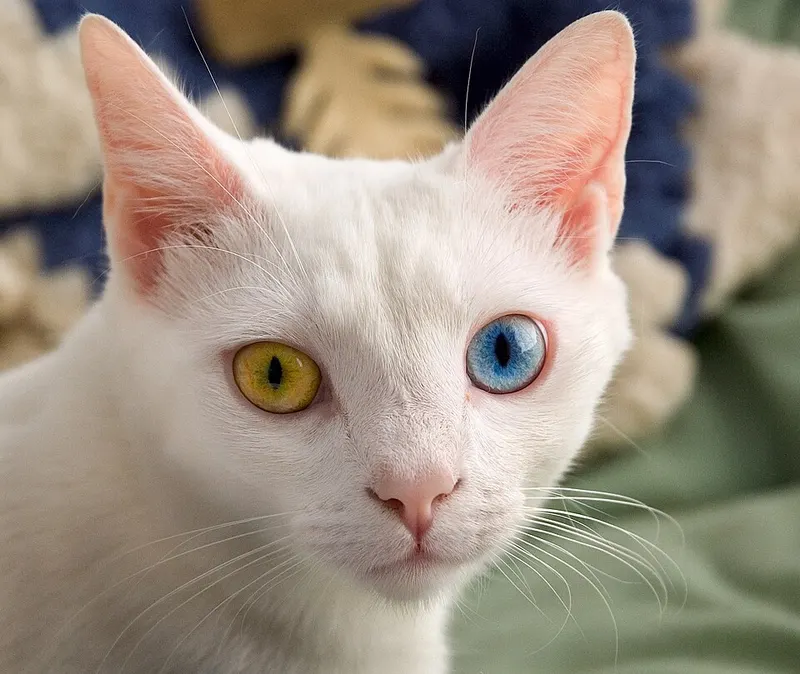
W). White all over, with one gold eye and one blue. The blue iris has no pigment cells: the same gap that raises the chance of deafness. Photo: Keith Kissel, CC BY 2.0, via Wikimedia Commons

S. Some pigment cells still reach the skin, so a few patches keep their color. Photo: Effervescing Elephant, CC BY-SA 2.0, via Wikimedia Commons


How dominant white works
Pigment cells (melanocytes) start in the embryo’s neural crest and travel through the body to the skin, the iris and the inner ear. The KIT gene helps them survive and spread. In cats, W and S both come from an old virus-like DNA sequence inserted in KIT: a short remnant of it (one end of the sequence) gives dominant white, and the full-length insertion gives white spotting.
With W, so few pigment cells arrive that the coat is white all over. Some white kittens may show a small colored patch on the head, which often fades as they grow.
Because W is dominant and hides every other color gene, it’s a good example of dominant epistasis:
- A
W/wwhite cat can still carry black, tabby, dilute or orange alleles, which can show up in its non-white kittens. - You can’t tell from a white cat’s coat what colors it carries.
Why some white cats are deaf
Hearing needs pigment cells too. Inside the cochlea, a layer called the stria vascularis depends on melanocytes to keep the fluid around the hearing hair cells working. If too few pigment cells arrive, that layer breaks down in the first weeks after birth, and the hair cells die. The result is congenital sensorineural deafness in one ear or both.
Blue eyes are a sign of the same thing: an iris with no pigment cells looks blue. Blue eyes don’t cause deafness; both come from missing pigment cells. That’s why the link is strongest in white cats with two blue eyes.
What the hearing studies found
| White cats | Deaf in one or both ears: UK kittens, 2019 (BAER test) | Deaf in one or both ears: older studies |
|---|---|---|
| Two blue eyes | 50% | about 65–85% |
| One blue eye | 44% | about 40% |
| No blue eyes | 22% | about 17–22% |
| All solid white | 30% (16% both ears, 14% one ear) | about 50% |
The 2019 study tested 132 solid white purebred kittens and their 61 colored littermates with a brainstem auditory evoked response (BAER) test, which measures the brain’s response to sound. None of the colored littermates was deaf. The older figures come from studies published between 1965 and 1973, mostly of mixed-breed cats, as reviewed by Delack in 1984 and summarized by the Louisiana State University deafness program. The 2019 study tested purebred kittens, which explains some of the gap. Numbers vary between studies and breeds, but the pattern is the same: more blue eyes, higher chance of deafness.
A deaf kitten often isn’t obvious, especially if only one ear is affected. Vets check hearing with a BAER test.
Does breed make a difference?
Breed doesn’t change how W works. It’s the same allele in every breed that has solid white cats, and in mixed-breed cats too. Breeds do differ in two ways, though.
How common white is. Many breeds allow solid white, from Persians and British Shorthairs to Maine Coons and Norwegian Forest Cats. A few breeds are always white, such as the Thai Khao Manee and the Turkish Vankedisi, the pure white form of the Turkish Van. Watch the names: the Turkish Van itself isn’t solid white. Its van pattern comes from white spotting, not dominant white.
How often white kittens are deaf. In the 2019 UK study, the share of solid white kittens deaf in one or both ears varied by breed:
| Breed (solid white kittens) | Deaf / tested | Share deaf |
|---|---|---|
| Turkish Vankedisi | 7 of 15 | 47% |
| Maine Coon | 8 of 18 | 44% |
| Norwegian Forest | 18 of 41 | 44% |
| British Shorthair | 3 of 11 | 27% |
| Devon Rex | 2 of 12 | 17% |
| Persian | 1 of 12 | 8% |
| Russian (as named in the study) | 1 of 21 | 5% |
Most of these groups are small, so treat the percentages as rough. Once the researchers allowed for eye color, only Norwegian Forest kittens stood out, with about 2.5 times the odds of deafness of other white kittens. Why breeds might differ isn’t settled, and the authors call for larger studies. (The study’s summary gives 2 deaf Persian kittens; its table and percentage give 1.)


Worked crosses (coat color only)
White × colored: W/w × w/w
w | w | |
|---|---|---|
W | W/w white | W/w white |
w | w/w colored | w/w colored |
½ white, ½ colored. Check it in the calculator.
Hidden colors under white: W/w D/d × w/w D/d
Half the kittens are white. The other half show the colors hidden in both parents: ¾ black and ¼ blue among them. Overall: ½ white, ⅜ black, ⅛ blue. The white parent’s dilute allele only shows in its colored kittens. Check it.
White spotting: S/w × S/w
¼ with a lot of white (S/S), ½ with white (S/w), ¼ no white (w/w). One copy of S usually gives less white than two, though the amount varies a lot from cat to cat. Check it.
Common questions
Are all white cats deaf?
No. Most white cats in the 2019 study heard normally. The chance is higher than for colored cats, not certain.
Do blue eyes make a cat deaf?
No. Blue eyes and deafness share a cause; one doesn’t cause the other. Siamese and other pointed cats have blue eyes for a different reason (pigment cells that are present but make less pigment, not missing pigment cells), so the white-cat figures above don’t apply to them.
Can you tell a white cat’s hidden colors from its coat?
No. W hides them all; only its kittens or a DNA test reveal them.
Is a white cat the same as an albino cat?
No. Albinism is a different gene (TYR) and is rare in cats.
Practice
- Two white cats, both
W/w, have kittens. What fraction are expected to be white? - A white cat has a black kitten with a black partner. What is the white parent’s genotype at KIT?
- Why can’t a coat color calculator tell you whether a white kitten will be deaf?
Answers
- ¾ (
W/WandW/w). The other ¼ arew/wand show their color genes. W/w. The black kitten isw/w, so it received awfrom each parent.- Deafness depends on how many pigment cells reach the inner ear, which varies between cats with the same genotype. Being white raises the chance but doesn’t decide it.
Where the model stops
- Hearing isn’t predictable from genotype. The figures above are group averages, not a forecast for one kitten.
- The amount of white from
Svaries widely, and there are white-spotting variants not shown here. - This page gives no breeding or veterinary advice. For a particular cat’s hearing, see a vet.
Related
- Cat coat color calculator: set the white gene for both parents
- Siamese cat genetics: blue eyes from a different gene
- Calico and orange cats: white spotting turns tortoiseshell into calico
- Beyond Mendelian inheritance: epistasis and other exceptions
Sources
- Mari L, Freeman J, Van Dijk J, De Risio L. “Prevalence of congenital sensorineural deafness in a population of client-owned purebred kittens in the United Kingdom.” Journal of Veterinary Internal Medicine 33, 1707–1713 (2019). doi:10.1111/jvim.15515
- Strain GM, Louisiana State University, Cat breeds with congenital deafness (summary of Bergsma & Brown 1971, Mair 1973 and Delack 1984).
- David VA, et al. “Endogenous retrovirus insertion in the KIT oncogene determines white and white spotting in domestic cats.” G3 4, 1881–1891 (2014). doi:10.1534/g3.114.013425
- Imes DL, Geary LA, Grahn RA, Lyons LA. “Albinism in the domestic cat (Felis catus) is associated with a tyrosinase (TYR) mutation.” Animal Genetics 37, 175–178 (2006). doi:10.1111/j.1365-2052.2005.01409.x
- Governing Council of the Cat Fancy, Turkish Van & Turkish Vankedisi (the Vankedisi is the pure white form).
- MedlinePlus Genetics, Piebaldism and Waardenburg syndrome.